
Companion Guide
Understanding airplane axes and control surfaces
Airplanes can move in ways that feel complicated at first: one wing can go down, the nose can rise, or the nose can swing left or right. Pilots describe those movements using three imaginary lines called axes.
In this guide, you will learn the three airplane axes, the movements called roll, pitch, and yaw, and the primary control surfaces that help create those movements: ailerons, elevator, and rudder.
What this guide helps you understand
By the end of this guide, you should be able to:
- Name the three airplane axes: longitudinal, lateral, and vertical.
- Match each axis with the movement around it: roll, pitch, and yaw.
- Identify the primary control surfaces: ailerons, elevator, and rudder.
- Understand the basic job of each primary control surface.
- Avoid common beginner mix-ups between axes, movements, and control surfaces.
The big idea
An airplane can rotate around three imaginary lines, or axes. Each axis helps describe a different kind of movement.
Roll is movement around the longitudinal axis. Pitch is movement around the lateral axis. Yaw is movement around the vertical axis.
The primary control surfaces help the pilot control these movements. Ailerons help control roll, the elevator helps control pitch, and the rudder helps control yaw.
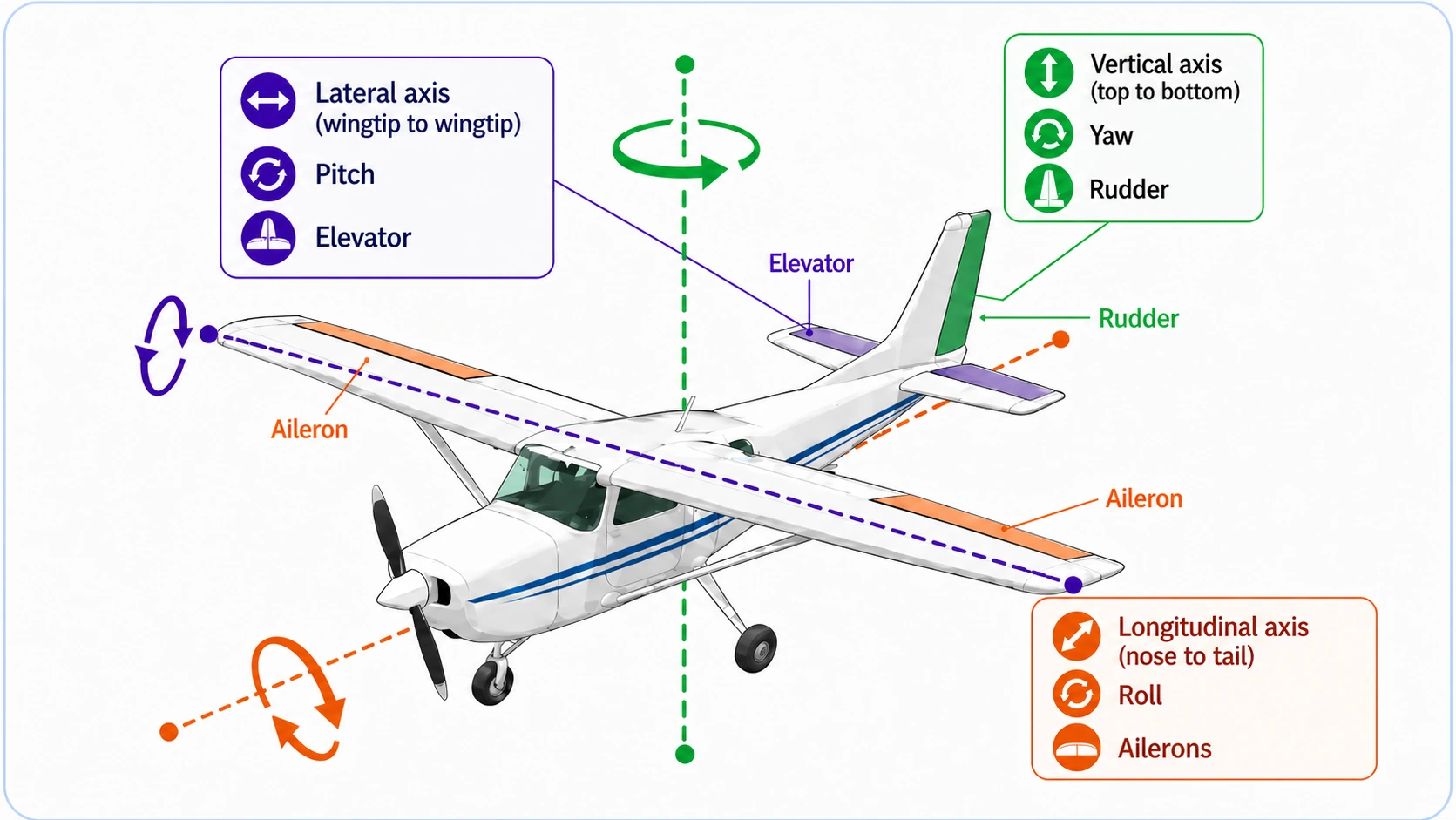
Longitudinal axis → roll → ailerons. Lateral axis → pitch → elevator. Vertical axis → yaw → rudder.
Key terms
Axis
An imaginary line through the airplane that helps describe how the airplane rotates or turns in space.
Longitudinal axis
The imaginary line that runs from the nose of the airplane to the tail. Movement around this axis is called roll.
Lateral axis
The imaginary line that runs from wingtip to wingtip. Movement around this axis is called pitch.
Vertical axis
The imaginary line that runs up and down through the airplane. Movement around this axis is called yaw.
Roll
A banking movement where one wing moves down and the other wing moves up. Roll happens around the longitudinal axis.
Pitch
A nose-up or nose-down movement. Pitch happens around the lateral axis.
Yaw
A left or right movement of the airplane’s nose. Yaw happens around the vertical axis.
Ailerons
Movable control surfaces usually located near the outer trailing edges of the wings. Ailerons help control roll.
Elevator
A movable control surface usually located on the horizontal tail. The elevator helps control pitch.
Rudder
A movable control surface usually located on the vertical tail. The rudder helps control yaw.
How to think about it
A helpful beginner method is to separate three questions:
- What imaginary line is the airplane rotating around? That is the axis.
- What movement do you see? That is roll, pitch, or yaw.
- What control surface helps create that movement? That is the ailerons, elevator, or rudder.
Try not to memorize the words as one long list. Instead, learn them as three connected sets:
- Longitudinal axis → roll → ailerons
- Lateral axis → pitch → elevator
- Vertical axis → yaw → rudder
This connection is the heart of the topic.
The three airplane axes
Longitudinal axis: nose to tail
The longitudinal axis runs lengthwise through the airplane, from the nose to the tail. If the airplane rotates around this line, one wing goes down while the other wing goes up.
That movement is called roll. Ailerons are the primary control surfaces used to control roll.
Lateral axis: wingtip to wingtip
The lateral axis runs across the airplane from one wingtip to the other. If the airplane rotates around this line, the nose moves up or down.
That movement is called pitch. The elevator is the primary control surface used to control pitch.
Vertical axis: top to bottom
The vertical axis runs up and down through the airplane. If the airplane rotates around this line, the nose moves left or right.
That movement is called yaw. The rudder is the primary control surface used to control yaw.
Primary control surfaces
Ailerons: controlling roll
Ailerons are usually found near the outer trailing edges of the wings. They help the airplane roll, which is the banking motion around the longitudinal axis.
On many airplanes, the ailerons move in opposite directions. One aileron moves up while the other moves down, helping one wing produce less lift and the other wing produce more lift. This difference helps the airplane roll.
Elevator: controlling pitch
The elevator is usually located on the horizontal tail. It helps control pitch, which is the nose-up or nose-down movement around the lateral axis.
When the pilot changes elevator position, the airplane’s nose can be encouraged to move up or down. For beginners, the key idea is simple: elevator is connected to pitch.
Rudder: controlling yaw
The rudder is usually located on the vertical tail. It helps control yaw, which is the left or right movement of the nose around the vertical axis.
The rudder is controlled by the pilot’s feet in many airplanes. It is especially important for coordinated flight, ground operations, takeoff, landing, and managing certain left-right tendencies.
Putting the system together
It can help to imagine the airplane as a three-dimensional object rather than a flat picture. The airplane can rotate lengthwise, side-to-side, or up-and-down around its three axes.
Each primary control surface gives the pilot a way to influence one of those main rotations:
- Ailerons help bank the wings by controlling roll.
- Elevator helps raise or lower the nose by controlling pitch.
- Rudder helps move the nose left or right by controlling yaw.
In real flying, these controls often work together. For this beginner guide, focus first on matching each control with its main movement.
Common beginner mix-ups
Axis vs. movement
The axis is the imaginary line. The movement is what the airplane does around that line. For example, the longitudinal axis is the line; roll is the movement around it.
Roll vs. yaw
Roll is the banking motion where one wing lowers and the other rises. Yaw is the nose moving left or right. They can happen together in flight, but they are not the same movement.
Elevator vs. rudder
The elevator is usually on the horizontal tail and helps control pitch. The rudder is usually on the vertical tail and helps control yaw.
Aileron vs. flap
Ailerons help control roll. Flaps are also on the wings, but their main beginner-level purpose is different: they help change lift and drag for takeoff and landing. Do not treat flaps as the primary roll control.
Quick example
Imagine a small training airplane beginning a gentle turn to the left.
The pilot uses the ailerons to roll the airplane left, so the left wing lowers and the right wing rises. The airplane is now banked. The pilot may also use rudder to help keep the airplane coordinated, so the nose does not swing in an unwanted way.
If the pilot wants to adjust the nose up or down during the maneuver, the elevator affects pitch. In one simple moment, you can see how roll, yaw, and pitch can all matter, even though each has its own main control connection.
Quick recap
- An airplane has three main axes: longitudinal, lateral, and vertical.
- Roll happens around the longitudinal axis.
- Pitch happens around the lateral axis.
- Yaw happens around the vertical axis.
- Ailerons help control roll.
- The elevator helps control pitch.
- The rudder helps control yaw.
Before you continue
Before taking or retaking the related quiz, make sure you can answer these questions in your own words:
- What are the three airplane axes?
- Which axis runs from the nose to the tail?
- Which movement is controlled primarily by ailerons?
- Which movement is controlled primarily by the elevator?
- Which movement is controlled primarily by the rudder?
- What is the difference between roll and yaw?
Related quiz and next step
Continue your learning path
Return to the Learning Resources library or jump back into quizzes when you are ready for the next concept.