
Companion Guide
Understanding the Four Forces of Flight
Every airplane in flight is affected by four main forces: lift, weight, thrust, and drag. These forces may sound technical at first, but the basic idea is very approachable.
In this guide, you will learn what each force does, how the forces work together, and why pilots think about balance and change throughout a flight.
What this guide helps you understand
By the end of this guide, you should be able to:
- Name the four forces of flight.
- Explain the basic job of lift, weight, thrust, and drag.
- Understand that the forces act as a connected system, not as isolated facts.
- Recognize what happens when the forces are balanced or unbalanced.
- Avoid common beginner mix-ups between force, motion, and airplane parts.
The big idea
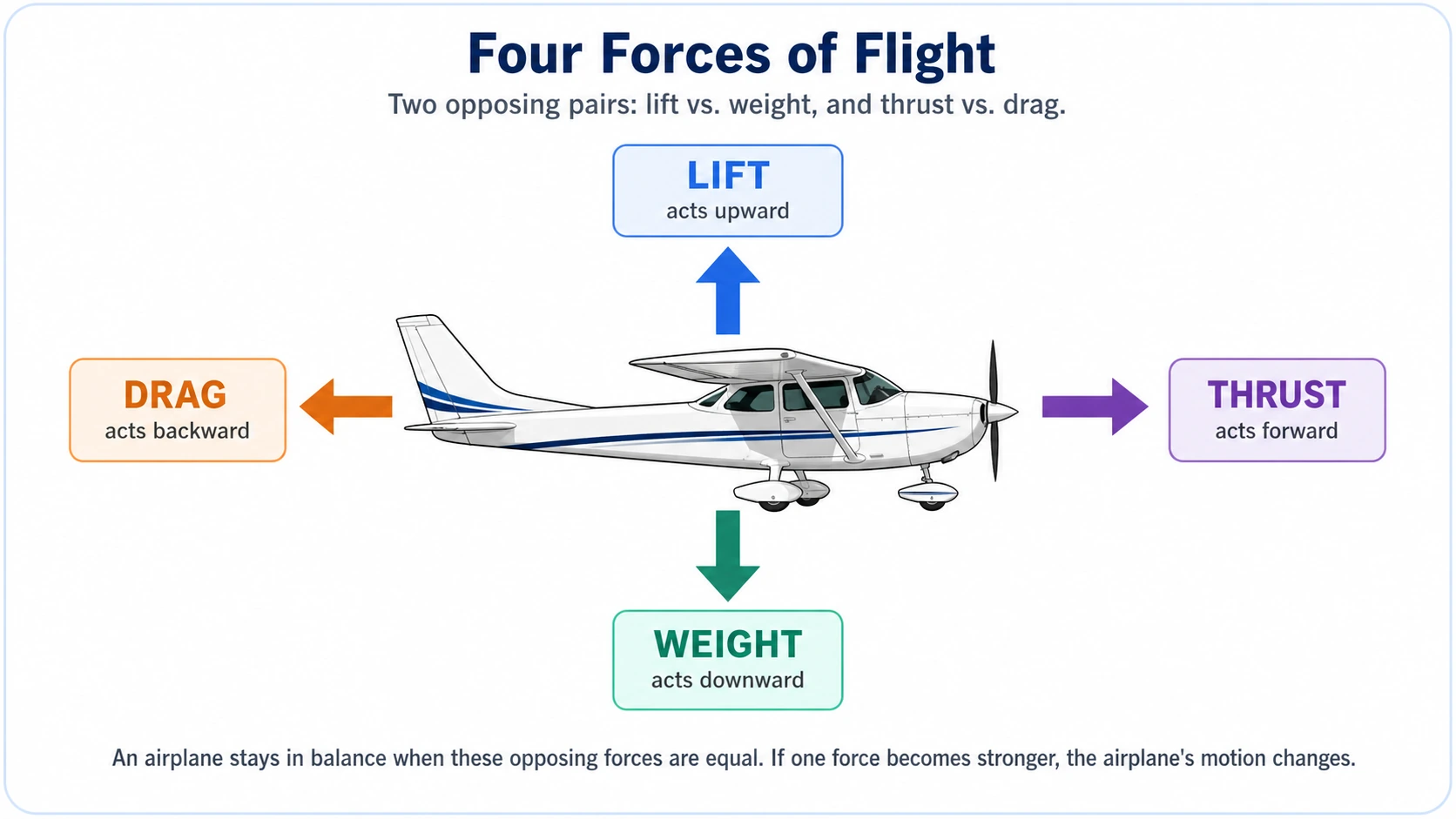
Flight happens because forces are acting on the airplane at the same time. Lift generally acts upward, weight acts downward, thrust moves the airplane forward, and drag resists that forward motion.
A helpful beginner mental model is to think in pairs. Lift works against weight. Thrust works against drag. When those forces are balanced, the airplane can keep doing what it is doing. When one force becomes stronger than the force opposing it, the airplane changes its motion.
You do not need advanced math to start understanding this. Begin with direction, balance, and change.
Key terms
Lift
The upward-acting force created mainly by the wings as air moves around them. Lift helps support the airplane in flight.
Weight
The downward-acting force caused by gravity. Weight pulls the airplane toward the Earth and includes the airplane, fuel, people, baggage, and cargo.
Thrust
The forward-acting force produced by the powerplant, such as a propeller or jet engine. Thrust helps move the airplane through the air.
Drag
The rearward-acting force that resists an airplane’s movement through the air. Drag increases when the airplane must push more air out of the way or creates more airflow resistance.
Balanced forces
A condition where opposing forces are equal enough that the airplane continues its current motion, such as maintaining steady altitude or steady speed.
Unbalanced forces
A condition where one force is stronger than the force opposing it, causing the airplane’s motion to change.
How to think about it
A simple way to organize the four forces is to picture two pairs:
- Lift vs. weight: the vertical pair.
- Thrust vs. drag: the forward-and-back pair.
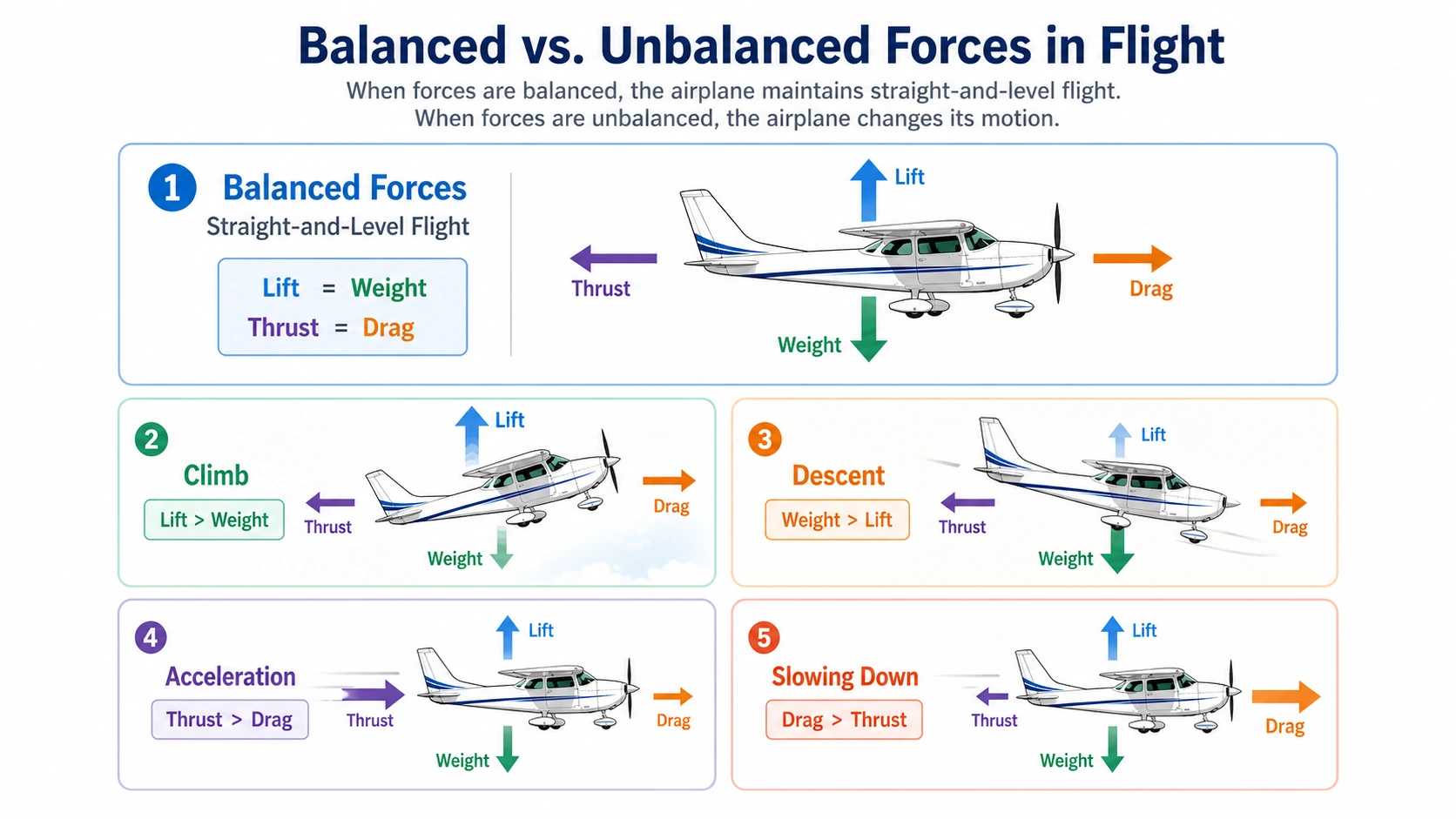
If lift is roughly equal to weight, the airplane can maintain altitude. If lift is greater than weight, the airplane may climb. If weight is greater than lift, the airplane may descend.
If thrust is roughly equal to drag, the airplane can maintain speed. If thrust is greater than drag, the airplane may accelerate. If drag is greater than thrust, the airplane may slow down.
This is the core beginner idea: forces explain why the airplane keeps doing what it is doing, or why it changes.
Main forces in flight
Lift: support from the wings
Lift is the force that helps support the airplane in the air. On most airplanes, the wings are the main lift-producing structures. As the airplane moves forward, air flows around the wings, and that airflow helps create lift.
Beginners sometimes think lift is a mysterious force, but the practical starting point is simple: wings need airflow to help create lift. That is why forward motion matters.
Weight: gravity pulling downward
Weight is the force of gravity pulling the airplane downward. It includes everything onboard: the aircraft itself, fuel, passengers, baggage, and cargo.
Because weight acts downward, the airplane needs enough lift to support it in flight. A heavier airplane generally needs more lift than a lighter one.
Thrust: forward motion from power
Thrust is the force that moves the airplane forward. In many small training airplanes, the engine turns a propeller that moves air backward, helping pull or push the airplane forward. In jet aircraft, jet engines produce thrust in a different way, but the basic role is still forward motion.
Thrust is important because forward motion creates airflow over the wings, and airflow supports lift.
Drag: resistance from the air
Drag is the force that resists the airplane’s motion through the air. Any object moving through air has to push air out of the way, and that creates resistance.
Some drag is unavoidable. Airplanes are designed to manage drag so they can fly efficiently, but pilots still need to understand that drag works against thrust.
Forces during different parts of flight
Straight-and-level flight
In steady straight-and-level flight, lift is roughly balancing weight, and thrust is roughly balancing drag. The airplane is not climbing, descending, speeding up, or slowing down in a major way.
Climb
During a climb, the airplane is changing its vertical position. The exact force picture can get more detailed in advanced aerodynamics, but the beginner takeaway is that the airplane needs enough lift, thrust, and airspeed management to climb safely.
Descent
During a descent, the airplane is moving downward in a controlled way. A descent does not mean the airplane has stopped flying. The pilot is managing pitch, power, airspeed, and drag so the airplane descends safely.
Acceleration and slowing down
When thrust is greater than drag, the airplane may speed up. When drag is greater than thrust, the airplane may slow down. This is why changing power or configuration, such as adding flaps, can affect speed.
Common beginner mix-ups
Lift vs. thrust
Lift acts mostly upward and helps support the airplane. Thrust acts mostly forward and helps move the airplane through the air. They are connected because forward motion supports airflow over the wings, but they are not the same force.
Weight vs. drag
Weight acts downward because of gravity. Drag acts backward against the airplane’s motion through the air. Both oppose something, but they act in different directions.
Balanced does not mean stopped
Balanced forces can mean the airplane continues moving steadily. For example, an airplane can be flying forward at a constant speed even though thrust and drag are balanced.
A descent is not the same as falling
A controlled descent is still normal flight. The airplane is still producing lift, and the pilot is managing the forces so the airplane descends safely.
Quick example
Imagine a small training airplane beginning its takeoff roll. The engine and propeller create thrust, moving the airplane forward. As speed increases, more air flows over the wings, and the wings can create more lift.
Weight is still pulling downward, and drag is still resisting motion through the air. When the airplane has enough speed and lift for the takeoff, it can leave the runway and begin climbing.
Nothing magical happened in one instant. The forces changed as the airplane accelerated, and the airplane’s motion changed with them.
Quick recap
- The four forces of flight are lift, weight, thrust, and drag.
- Lift generally acts upward and weight acts downward.
- Thrust moves the airplane forward and drag resists that motion.
- Lift works against weight; thrust works against drag.
- Balanced forces help the airplane continue its current motion.
- Unbalanced forces cause the airplane’s motion to change.
Before you continue
Before taking or retaking the related quiz, make sure you can answer these questions in your own words:
- What are the four forces of flight?
- Which force acts upward?
- Which force acts downward?
- Which force moves the airplane forward?
- Which force resists forward motion?
- What does it mean when opposing forces are balanced?
Related quiz and next step
Continue your learning path
Return to the Learning Resources library or jump back into quizzes when you are ready for the next concept.