
Companion Guide
Start with the airplane as a system
An airplane can look complicated at first, but you do not need to memorize every small part right away. A helpful first step is to see the airplane as a collection of major parts that each have a job.
In this guide, you will learn how the main parts of an airplane fit together, what each part does, and how to think about the airplane as one connected flying machine.
What this guide helps you understand
By the end of this guide, you should be able to:
- Recognize the major parts of a typical airplane.
- Explain the basic job of the fuselage, wings, tail, landing gear, and engine or propeller system.
- Understand why airplane parts are shaped and placed the way they are.
- Avoid common beginner mix-ups between airplane parts and flight controls.
The big idea
The main parts of an airplane are not separate random pieces. They work together to support flight, control, balance, movement, and safe operation on the ground.
The wings help create lift. The fuselage holds the people, cargo, and many systems. The tail helps keep the airplane stable. The landing gear supports the airplane on the ground. The engine and propeller, or jet engine on some aircraft, help move the airplane forward.
Once you see each part by its job, airplane structure becomes much easier to understand.
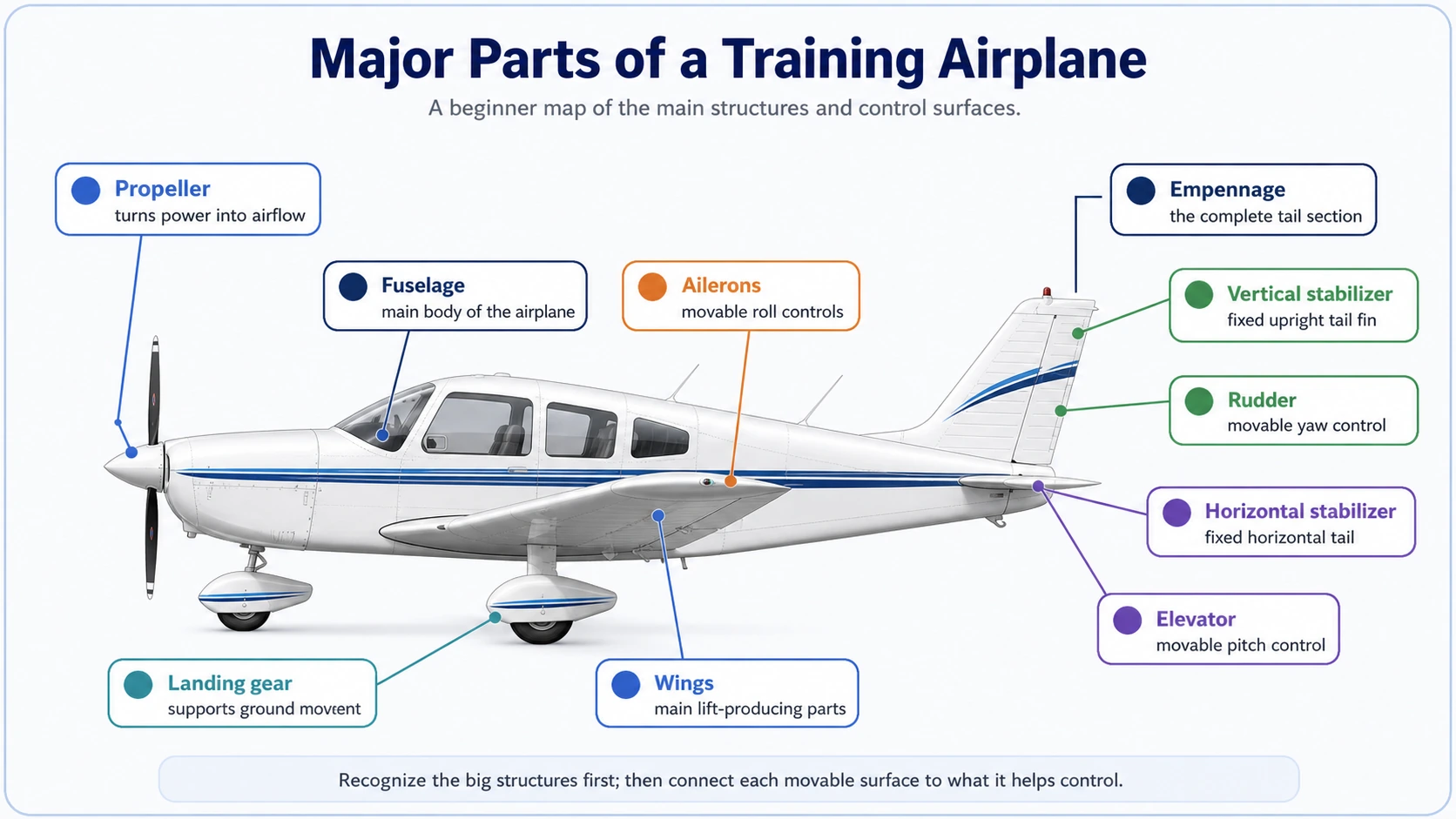
Key terms
Fuselage
The main body of the airplane. It usually holds the cockpit, passengers, cargo, and many internal systems.
Wings
The large side structures designed to help create lift as air moves around them.
Empennage
The tail section of the airplane. It includes parts that help with stability and control.
Landing gear
The wheels, struts, and support structures that allow the airplane to taxi, take off, land, and rest on the ground.
Powerplant
The engine system that produces power. On many small airplanes, this includes the engine and propeller.
Flight controls
Movable surfaces, such as ailerons, elevators, and rudders, that help the pilot control the airplane.
How to think about it
A useful way to remember airplane parts is to connect each part to a simple question:
- Where do people and systems go? The fuselage.
- What helps the airplane create lift? The wings.
- What helps the airplane stay stable? The tail, also called the empennage.
- What supports the airplane on the ground? The landing gear.
- What helps move the airplane forward? The powerplant.
- What helps the pilot control movement? The flight control surfaces.
This mental model keeps the airplane from feeling like a list of names. Each part has a purpose.
Main parts of a typical airplane
Fuselage: the central body
The fuselage is the main body of the airplane. On many airplanes, it contains the cockpit, cabin, baggage area, fuel lines, wiring, and other systems. You can think of it as the central structure that other major parts attach to.
Wings: the lift-producing structures
The wings extend out from the fuselage. Their shape helps air move in a way that supports lift. Wings may also hold fuel tanks, lights, and flight controls such as ailerons and flaps.
Tail section: stability and control
The tail section, or empennage, usually includes a vertical stabilizer and horizontal stabilizer. These parts help the airplane stay stable, much like feathers on an arrow help it fly straight. The rudder and elevator are commonly located on the tail.
Landing gear: support on the ground
Landing gear supports the airplane when it is not flying. It lets the airplane taxi, take off, and land. Some landing gear is fixed and stays down all the time. Some landing gear is retractable and folds into the airplane after takeoff.
Powerplant: forward motion
The powerplant provides the force that moves the airplane forward. On many training airplanes, the engine turns a propeller. The propeller pushes or pulls air backward, which helps move the airplane forward.
Common beginner mix-ups
Wing vs. aileron
The wing is the main structure. The aileron is a movable control surface usually attached near the outer trailing edge of the wing. The wing creates lift; the ailerons help control roll.
Tail vs. rudder
The tail is the larger section at the back of the airplane. The rudder is a movable part on the vertical tail. The tail helps with stability; the rudder helps control yaw.
Engine vs. propeller
The engine produces power. The propeller turns that power into moving air. They work together, but they are not the same part.
Landing gear vs. brakes
Landing gear includes the wheels and support structure. Brakes are part of the ground-control system that helps slow or stop the airplane after landing or while taxiing.
Quick example
Imagine looking at a small training airplane from the side before a lesson.
The long central body is the fuselage. The wings stretch out from the middle. The tail is at the back. The landing gear touches the ground. At the front, the engine and propeller are ready to help move the airplane forward.
Now imagine the airplane beginning its takeoff roll. The landing gear supports it on the runway, the powerplant moves it forward, the wings begin creating lift, and the tail helps keep the airplane stable and controllable. The parts are all doing different jobs, but they are working together.
Quick recap
- The fuselage is the main body of the airplane.
- The wings help create lift.
- The tail section helps with stability and control.
- The landing gear supports the airplane on the ground.
- The powerplant helps move the airplane forward.
- Flight controls are movable surfaces that help the pilot control the airplane.
Before you continue
Before taking or retaking the related quiz, make sure you can answer these questions in your own words:
- What is the fuselage, and why is it important?
- What is the basic job of the wings?
- Why does an airplane need a tail section?
- What does the landing gear do?
- How are the engine and propeller related?
- What is the difference between a major airplane part and a movable flight control?
Related quiz and next step
Continue your learning path
Return to the Learning Resources library or jump back into quizzes when you are ready for the next concept.